
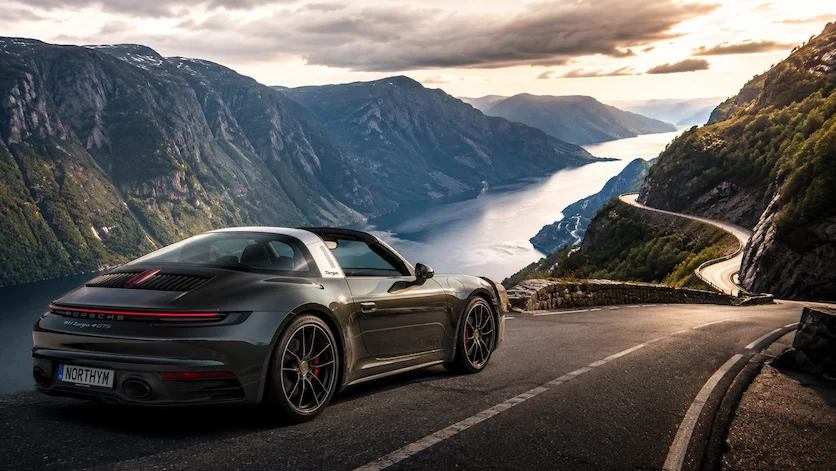
Norway was made for driving slowly. Glacier-cut valleys, fjord-edge ledges and mountain passes that climb well above the treeline give this country some of the most rewarding roads in Europe — and a surprising number of them sit within a day of Stavanger. From our base in Rogaland, here are the roads we return to, beginning on our own doorstep and ending with the icons worth the longer journey north.
What makes a great Norwegian driving road
Speed has little to do with it. The reward is the rhythm of the road, the place it takes you, and where you choose to stop along the way — a quiet viewpoint, a fjordside café, the moment the valley opens up. That is the Norwegian idea of friluftsliv, open-air life, carried onto four wheels.
On Stavanger’s doorstep: Ryfylke and the Jæren coast
Lysevegen — 27 hairpin bends down to Lysebotn
If you drive only one mountain road in the southwest, make it this one. Lysevegen winds down to Lysebotn at the very end of the Lysefjord through a relentless series of hairpins, including a corkscrew tunnel bored through the mountain itself. Near the top sits Øygardstøl, the viewpoint and trailhead for the hike to Kjerag. It is narrow, single-track in places, and best taken at an unhurried pace — which is exactly the point.
The Ryfylke National Scenic Route
One of Norway’s eighteen official Scenic Routes, Ryfylke threads 260 kilometres of fjords, waterfalls and quiet inland valleys north and east of the city. What makes it remarkable for us is the way in: you reach it from Stavanger through the Ryfylke Tunnel, the longest and deepest subsea road tunnel in the world. You descend almost three hundred metres below the fjord, then surface into some of the calmest scenery in the region. Unlike the high passes, much of this route stays drivable year-round.
The Jæren coast
For something gentler, turn south. The Jæren coastline — another of the national Scenic Routes — trades hairpins for long sand beaches, lighthouses and flat farmland running straight into the North Sea. It is the quiet counterpoint to the fjords: wide skies, open horizons, and a coffee with the car and the sea in the same frame. It is also the most reliable option in poor weather or out of season.
Worth the journey: Norway’s national icons
These three lie beyond comfortable day-trip range from Stavanger, in the western and inner fjord country. They are the roads that put Norway on every driver’s list, and each is worth planning a trip around.
Trollstigen — the Troll’s Ladder
Eleven hairpin bends climb the near-vertical mountainside in Romsdalen, with the Stigfossen waterfall falling 320 metres alongside the road. After major rockfall protection work, Trollstigen returned to a normal season in 2026, opening in late April. It remains weather-dependent and can close at short notice during heavy rain, so it is always worth checking the road status before you set off.
Atlanterhavsveien — the Atlantic Ocean Road
Just 8.3 kilometres long, and once voted Norway’s Construction of the Century, the Atlantic Ocean Road leaps from island to island across eight bridges over open sea. The curved Storseisundet Bridge — the “bridge to nowhere” — appears to launch straight into the Atlantic when you approach from the right angle. On a calm day it is serene; in an autumn storm, with waves breaking over the road, it is one of the most dramatic drives anywhere. It stays open all year.
Aurlandsfjellet — the Snow Road
Known as Snøvegen, the Snow Road crosses the high plateau between Aurland and Lærdal, topping out above 1,300 metres in a bare, almost lunar landscape that holds snowbanks deep into summer. Most visitors drive up to the Stegastein viewpoint above Aurland, take the photograph and turn back — but the full crossing over the mountains is the real prize, and far quieter. The contrast is the appeal: you climb out of lush fjord country into something closer to the Arctic in the space of half an hour. Strictly a summer road, and one to attempt only in clear weather.
When to drive, and how to do it well
The driving season in Norway runs from May to September. Outside those months the high passes are closed and the weather rarely cooperates. Within it, conditions still change quickly: a clear morning can turn, and snow lingers on the plateaus long after the valleys are green.
A few habits make every one of these roads better. Start early to have the hairpins to yourself, before the camper vans and tour coaches arrive. Give way to oncoming traffic on single-track sections rather than forcing the pass — there are designated passing places, and patience is faster in the end. Keep fuel in mind, since stretches like Lysevegen and the Snow Road run far from the nearest station. And build in time to stop, because these are not roads to rush through; the best moments tend to happen when you pull over.
The car matters too. The same bend feels entirely different in a vehicle that responds the way you want it to, and the same viewpoint lands differently when the car parked beside you is one you actually wanted to drive. That is the experience we exist to offer from Stavanger — the road, the season and the right car, without the commitment of owning it.
When is the best time to drive Norway’s mountain roads?
May to September. High mountain passes such as Lysevegen, Trollstigen and Aurlandsfjellet are closed by snow in winter and typically open from late May or June until October. Coastal roads like the Atlantic Ocean Road and the Jæren coast stay open all year.
Which is the best driving road near Stavanger?
Lysevegen, with its 27 hairpin bends down to Lysebotn, is the standout within easy reach of Stavanger. For a longer, gentler day, the Ryfylke National Scenic Route — accessed through the record-breaking Ryfylke Tunnel — is hard to beat.
Are these roads difficult or dangerous to drive?
They are public, fully paved roads, but several are narrow, single-track and steep, with tight hairpins and the occasional reverse-camber bend. They are safe when driven calmly and with respect for the weather. Slow down, use the passing places, and check road status before mountain crossings.
Do I need a special car to enjoy them?
Any roadworthy car will get you there. But these roads reward a car that engages you — which is where Northym comes in. We give you access to cars like the Porsche 911 Targa 4 GTS for a single day or across a season, without the cost of ownership.
How can I drive these roads with Northym?
Northym offers two ways in: a single-day experience for a specific occasion, and season membership for regular driving days. We are based in Stavanger and operate from May to September. To enquire or apply, write to post@northym.no or call +47 919 00 133.